
Residential Addiction Treatment: What to Expect and How It Works
Residential addiction treatment provides a structured environment where a person lives at a treatment facility while receiving care for a substance use disorder.
Instead of returning home after appointments, residents remain in a treatment setting where daily schedules, counseling, recovery activities, meals, peer support, and other services are organized around treatment.
Residential care is not automatically the right option for everyone. The appropriate level of care depends on substance use, withdrawal risk, physical and mental health, recovery environment, previous treatment, safety, and the amount of structure a person needs.
Current addiction-treatment standards emphasize matching people to the least intensive level of care that can still safely and effectively meet their needs, then reassessing as treatment progresses. ASAM
For a broader introduction to addiction care, read what drug rehab is.

What Is Residential Addiction Treatment?
Residential treatment is a form of addiction care in which a person stays overnight at a treatment facility and participates in a structured treatment program.
Care may include individual counseling, group therapy, substance-use education, mental-health treatment, recovery planning, medication management, peer support, family services, and other clinical or supportive services depending on the program.
Residential care also gives people temporary separation from environments where substance use, instability, or triggers may make early recovery more difficult.
ASAM recognizes multiple intensities of adult residential addiction treatment rather than treating every residential facility as the same level of care. ASAM
The how rehab works guide explains how assessment, treatment planning, and continuing care fit together.
Residential Treatment vs. Inpatient Rehab: Are They the Same?
The terms residential rehab and inpatient rehab are often used interchangeably on treatment websites, which can make treatment choices confusing.
Structured Live-In Care
Both residential and inpatient settings can involve staying overnight at a facility.
Some residential programs focus primarily on therapy, structure, peer support, and recovery skills. Others provide greater medical and psychiatric support.
Higher Medical Capability When Needed
Hospital-based or more medically intensive inpatient services may be appropriate when someone has needs that cannot be safely managed in a standard residential environment.
Staffing, medical services, withdrawal-management capacity, and psychiatric support matter more than the marketing label alone.
Current ASAM standards recognize several distinct residential levels with different capabilities. ASAM
Readers who need more information about medically structured care can review inpatient drug rehab.
Who May Benefit From Residential Treatment?
Residential treatment may be considered when a person needs more structure and support than can reasonably be provided through standard outpatient care.
For example, someone's current environment may expose them constantly to substance use, conflict, unstable housing, or other factors that interfere with treatment.
Residential care may also be appropriate when substance use has caused major disruption to daily functioning, when previous lower-intensity treatment has not provided enough support, or when co-occurring mental-health symptoms require more integrated services.
The decision should still be based on a multidimensional assessment.
ASAM's approach considers substance-use risks together with physical health, psychiatric needs, recovery environment, individual preferences, and barriers to care. ASAM
Residential treatment should not be described as “better” than outpatient treatment. It is a different level of care for people whose needs justify that level of structure.
How Does Residential Treatment Begin?
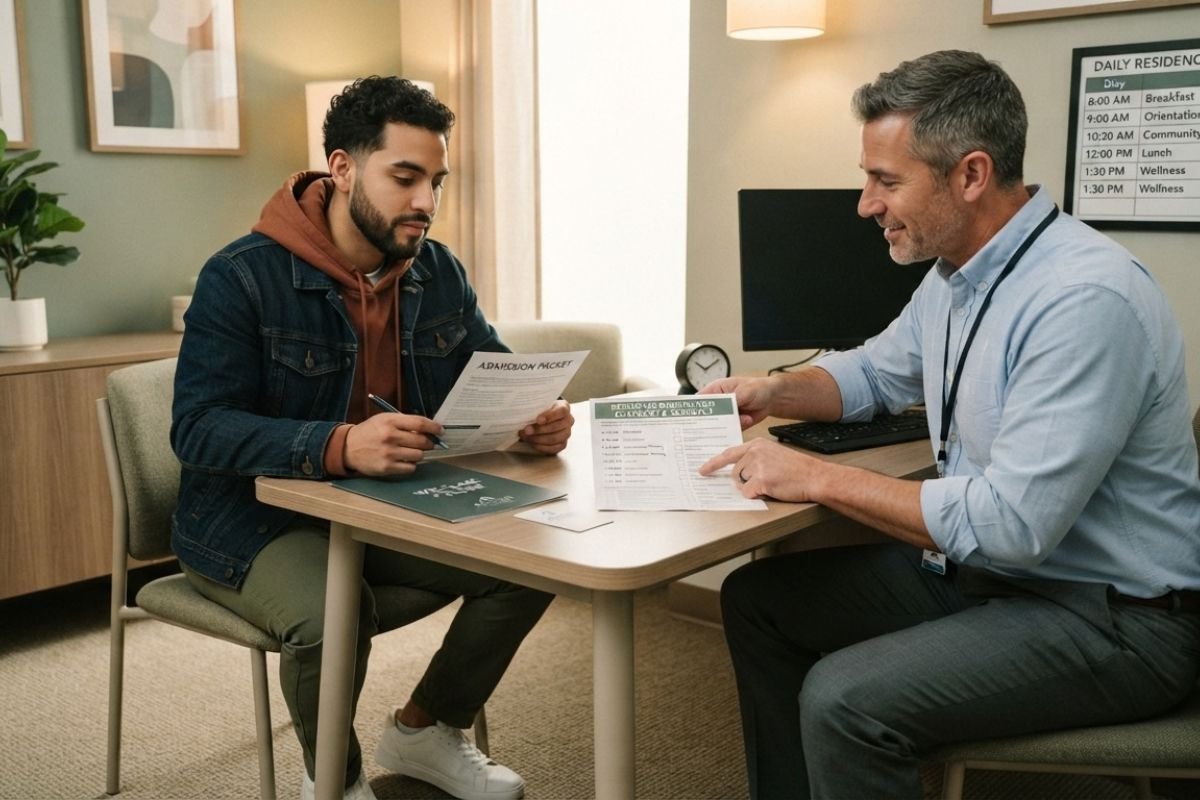
Admission generally begins with an assessment of the person's substance use, withdrawal risk, medical history, mental health, medications, previous treatment, living environment, safety, and treatment goals.
SAMHSA recommends creating an individualized treatment plan after the care team develops a clear understanding of the person's needs. SAMHSA
The assessment may show that the person can enter residential treatment directly.
In other situations, withdrawal needs must be addressed first.
Once residential care begins, the treatment plan should continue to change as the person's clinical needs and recovery progress become clearer.
Does Residential Treatment Include Detox?
Sometimes, but not always.
Detox and residential treatment are not automatically the same service.
Withdrawal Management
Addresses withdrawal stabilization and medical safety when clinically needed.
Residential Treatment
Provides structured live-in addiction treatment, therapy, recovery work, and continuing-care planning.
Some residential programs can provide or coordinate clinically appropriate withdrawal management. Others require a person to complete withdrawal stabilization elsewhere before admission.
Current ASAM guidance specifically recognizes that withdrawal needs should be evaluated before placement, and some residential levels have greater withdrawal-management capability than others. ASAM
This distinction can be particularly important with alcohol, benzodiazepines, or other situations where withdrawal may require close medical supervision.
Before admission, ask whether the facility provides withdrawal management on site, coordinates it through another facility, or requires medical stabilization first.
For more information, see drug detox programs.
What Happens During Residential Rehab?
A residential treatment day is usually structured, but schedules vary by facility and individual treatment plan.
SAMHSA describes treatment as a collaborative process built around an individualized treatment plan. Residential programs commonly combine several clinical and recovery services rather than relying on one type of therapy. SAMHSA
Structure gives people time to focus more intensively on treatment while temporarily reducing many everyday distractions and environmental triggers.
The goal is not simply to keep someone away from substances. Treatment should help the person develop skills and a plan they can continue using after leaving the facility.

What Therapies Are Used in Residential Treatment?
Residential treatment can include several behavioral and supportive approaches.
A facility should be able to explain which therapies it actually provides rather than relying on the generic statement that it offers “evidence-based treatment.”
Can Residential Treatment Include Addiction Medications?
Yes.
Residential treatment and medication-based addiction care are not mutually exclusive.
People with opioid use disorder may need access to medications such as buprenorphine, methadone, or naltrexone. People with alcohol use disorder may be candidates for medications such as naltrexone or acamprosate.
ASAM's current residential standards emphasize patient-centered care and access to medications for addiction treatment. ASAM
When evaluating a program, ask whether it allows patients to continue medications they are already taking and whether it can initiate or coordinate appropriate medication treatment.
A facility should not require someone to discontinue an evidence-based addiction medication simply because the program defines recovery as being free of all medications.
Readers can learn more in the medication-assisted treatment guide.
What If Mental Health Conditions Are Also Present?
Depression, anxiety, PTSD, bipolar disorder, and other mental-health conditions frequently occur alongside substance use disorders.
Residential treatment may provide an opportunity to address both when the facility has appropriate clinical capability.
ASAM's current criteria treat co-occurring mental-health conditions as an expected part of addiction-treatment planning rather than an unusual exception. ASAM
Care may include psychiatric evaluation, psychotherapy, medication management, safety planning, or other mental-health services.
However, not every residential addiction facility has the same psychiatric capabilities.
Someone with substantial mental-health needs should ask exactly what services and staffing are available.
For more information, see dual diagnosis treatment.

Residential Treatment vs. Sober Living
Residential addiction treatment and sober living are not the same thing.
Clinical Treatment
Residential treatment is a clinical addiction-treatment service. Residents participate in an organized treatment program while staying at the facility.
Recovery Housing
Sober living or recovery housing is primarily a substance-free living environment designed to support recovery while the person participates in work, school, outpatient treatment, or everyday community life.
ASAM's Fourth Edition specifically distinguishes residential treatment from recovery residences, although certain clinical recovery residences may overlap with a low-intensity residential level. ASAM
A person may leave residential treatment and move into recovery housing while continuing outpatient care.
The future sober living and recovery housing guide can provide deeper information on that stage of care.
How Long Does Residential Treatment Last?
Residential treatment does not have one universally correct length.
Although programs may offer common timeframes such as 30, 60, or 90 days, those numbers should not automatically determine how long someone needs residential care.
ASAM specifically states that addiction-treatment duration should respond to the person's progress and evolving needs. As someone improves, they may transition to less intensive care; if needs increase, a more intensive service may become appropriate. ASAM
A person's stay may therefore depend on substance-use severity, progress, mental health, medical needs, recovery environment, insurance authorization, and the availability of appropriate follow-up services.
“How many days is your program?”
“How do you decide when someone is ready to move to the next level of care?”
What Happens After Residential Treatment?
Residential treatment should include planning for what happens after discharge.
A person may transition to a partial hospitalization program, intensive outpatient program, standard outpatient drug rehab, recovery housing, individual therapy, addiction medication management, peer support, or a combination of services.
This is sometimes called step-down care or continuing care.
The goal is to keep treatment connected as the person returns to greater independence.
Finishing residential treatment should therefore be understood as a transition in care rather than proof that someone no longer needs any recovery support.
How Common Is Residential Substance Use Treatment?
The data illustrate that overnight treatment represents only one part of the overall addiction-treatment system. SAMHSA
Residential care is appropriate for some people, while others can safely receive care through outpatient or medication-based services.
How to Choose a Residential Treatment Center
A residential program should be able to explain how it decides whether someone actually needs residential care.
How does the program determine whether residential care is appropriate?
What clinical staff are on site and what happens during medical or psychiatric emergencies?
Are evidence-based addiction medications continued, started, or coordinated when appropriate?
How are co-occurring mental-health conditions assessed and treated?
How are progress, discharge, and step-down decisions made?
What is covered, what requires authorization, and what may be billed separately?
ASAM offers an independent Level of Care Certification program for participating residential programs, covering several adult residential levels of care. Certification is one possible quality signal, although it is not the only factor to consider. ASAM
Does Insurance Cover Residential Treatment?
Health insurance may cover residential addiction treatment when the service is included in the plan and considered medically necessary, but benefits vary substantially.
Marketplace plans cover mental health and substance use disorder services as essential health benefits, including behavioral-health treatment and inpatient services, but the exact services, provider networks, deductibles, copayments, coinsurance, and authorization requirements vary by plan. HealthCare.gov
Coverage for “substance use treatment” does not automatically mean that every residential facility or every proposed length of stay will be covered.
Readers can use verify insurance for rehab to explore benefits or review how much rehab costs for broader cost information.
Frequently Asked Questions About Residential Treatment
What is residential addiction treatment?
Residential treatment is addiction care in which a person lives at a treatment facility while participating in a structured clinical program.
Is residential treatment the same as inpatient rehab?
The terms are often used interchangeably, but program intensity and medical capability can differ. Look at the actual staffing, medical services, psychiatric support, and level of care rather than relying on the label alone.
Does everyone need residential rehab?
No. Some people can be safely and effectively treated through outpatient, medication-based, or other community services.
Do you have to detox before residential treatment?
Not always. Some residential programs provide or coordinate withdrawal management, while others require stabilization before admission. ASAM
Can you take addiction medication in residential treatment?
Evidence-based medications can be part of residential treatment when clinically appropriate. Ask whether the facility provides or coordinates these medications. ASAM
What happens during residential rehab?
Treatment may include individual and group therapy, medical or psychiatric services, addiction education, recovery-skills work, peer support, family services, and discharge planning.
How long is residential addiction treatment?
There is no universal duration. Current treatment standards emphasize length of care based on progress and changing clinical needs rather than one predetermined number of days. ASAM
Can residential treatment address mental health conditions?
Some programs provide integrated mental-health treatment, but capabilities vary. People with significant psychiatric needs should confirm that the facility can safely provide the required level of care.
What happens after residential rehab?
Many people transition into PHP, IOP, standard outpatient care, recovery housing, medication management, therapy, peer support, or another form of continuing care.
Explore Residential Treatment Options
Residential treatment can provide a structured environment for people who need more support than outpatient treatment alone can provide.
The right decision should consider substance use, withdrawal risk, medical and mental-health needs, living environment, previous treatment, personal preferences, location, and insurance.
Important Safety Information
This page provides general educational information about residential addiction treatment. It is not a medical assessment or an individualized recommendation for a particular level of care.
Withdrawal from alcohol, benzodiazepines, or other substances can sometimes require medical supervision.
If an opioid overdose may be involved, give naloxone if available while emergency help is being contacted.
For a mental health, suicide, or substance-use crisis, call or text 988.