
Cognitive Behavioral Therapy
CBT helps people identify triggers, thoughts, behaviors, and situations associated with meth use and develop more effective coping strategies.
Meth addiction, clinically called methamphetamine use disorder, is a treatable stimulant use disorder. Treatment focuses primarily on behavioral interventions, mental-health care, recovery support, and an appropriate level of addiction treatment.
Unlike opioid or alcohol use disorder, there is currently no FDA-approved medication specifically for methamphetamine use disorder. Current ASAM/AAAP guidance identifies contingency management as a primary component of stimulant-use-disorder treatment, with cognitive behavioral therapy, the Community Reinforcement Approach, and the Matrix Model among the best-supported additional approaches. ASAM/AAAP
Treatment may take place in residential rehab, partial hospitalization, intensive outpatient care, standard outpatient services, or several settings over time.

Meth addiction is treated mainly with evidence-based behavioral therapies and individualized addiction care.
Contingency management has the strongest current evidence and should be considered a central component of treatment when available. Other approaches may include cognitive behavioral therapy, the Matrix Model, Community Reinforcement Approach, motivational interventions, counseling, psychiatric care, and recovery support. ASAM/AAAP
Some people can receive treatment while living at home. Others may benefit from residential care because of severe psychiatric symptoms, repeated return to use, other substance use, unstable housing, or the need for greater structure.
The broader how rehab works guide explains how assessment, treatment planning, and levels of care fit together.
Methamphetamine is a powerful central nervous system stimulant.
Not everyone who has used methamphetamine has a substance use disorder. Methamphetamine use disorder involves a broader pattern in which use becomes difficult to control and begins causing meaningful problems in health, relationships, work, finances, responsibilities, or safety.
Someone may use more than intended, repeatedly try to stop without success, experience strong cravings, spend substantial time obtaining or recovering from meth, or continue using despite serious consequences.
A professional assessment considers the whole pattern rather than relying on a single symptom.
SAMHSA's 2025 National Survey on Drug Use and Health estimated that approximately 2.65 million people aged 12 or older used methamphetamine during the past year, representing about 0.9% of that population. SAMHSA
The same national data estimate that approximately 1.81 million people aged 12 or older had methamphetamine use disorder in 2025. SAMHSA
Treatment should begin with an individualized assessment rather than automatically assigning everyone to the same rehab program.
A treatment professional may review the person's meth use, cravings, sleep, physical health, mental-health symptoms, other substances, previous treatment, medications, living environment, support system, and current safety concerns.
Special attention may be needed for severe depression, paranoia, hallucinations, agitation, cardiovascular symptoms, or other medical or psychiatric problems.
The assessment helps determine whether outpatient treatment is appropriate or whether a more structured level of care is needed.

Meth withdrawal may involve fatigue, strong cravings, depressed mood, anxiety, irritability, increased sleep or disrupted sleep, difficulty concentrating, and reduced ability to experience pleasure.
Some people describe an early “crash” after stopping stimulant use, followed by a longer period of low energy, sleep disturbance, cravings, or mood symptoms.
There is no universal day-by-day withdrawal timeline. Symptoms vary according to pattern of use, health, other substances, sleep deprivation, psychiatric conditions, and individual factors.
Current stimulant-treatment guidance recommends monitoring psychiatric symptoms during withdrawal because depression, psychosis, and suicidal thinking can emerge or worsen. PubMed Central
Anyone experiencing severe paranoia, hallucinations, suicidal thoughts, seizures, chest pain, or another urgent medical or psychiatric problem needs prompt professional evaluation.
Not everyone with methamphetamine use disorder needs a separate inpatient detox program.
Someone who is medically and psychiatrically stable may begin treatment in an outpatient setting. A more supervised setting may be appropriate when severe psychiatric symptoms, other substance use, serious medical concerns, or an unsafe recovery environment are present.
Withdrawal care may focus on rest, hydration, nutrition, sleep, psychiatric safety, medical monitoring, and preparation for ongoing treatment.
Getting through the initial withdrawal period does not treat the full disorder.
The broader plan may still need behavioral treatment, psychiatric care, recovery support, case management, and an appropriate level of rehab.
The drug detox programs guide can explain the role of withdrawal-management services in more detail.
Contingency management, or CM, is an evidence-based behavioral treatment that provides structured positive reinforcement when specific treatment goals are met.
Those goals may involve treatment attendance or objectively verified reductions in stimulant use.
ASAM/AAAP gives contingency management a strong recommendation with high certainty as a primary component of stimulant-use-disorder treatment. ASAM/AAAP
SAMHSA also describes CM as having a strong evidence base for stimulant use disorders. SAMHSA
This makes one practical question particularly useful when evaluating a meth treatment program:
A treatment center that treats methamphetamine exactly like every other substance may be missing one of the strongest evidence-based options available.

CBT helps people identify triggers, thoughts, behaviors, and situations associated with meth use and develop more effective coping strategies.
The Matrix Model was developed specifically for stimulant use disorders. It combines elements such as cognitive behavioral treatment, motivational strategies, education, relapse-prevention work, family involvement, and mutual-help support. SAMHSA maintains treatment manuals based on this approach. SAMHSA
CRA focuses on strengthening healthy relationships, activities, routines, and other sources of reward that can compete with continued substance use.
ASAM/AAAP identifies CBT, CRA, and the Matrix Model as preferred behavioral interventions to use alongside contingency management. ASAM/AAAP
There is currently no FDA-approved medication specifically for methamphetamine use disorder. ASAM
That does not mean medications never appear in treatment.
A clinician may prescribe medication for depression, anxiety, psychosis, another substance use disorder, or another medical condition.
Current ASAM/AAAP guidance also allows addiction specialists to consider certain medications off-label in selected patients. One example is the combination of bupropion and naltrexone, which has shown some benefit in research involving moderate-to-severe methamphetamine use disorder. However, the benefit has been modest, and this is not an FDA-approved meth treatment. ASAM/AAAP
Medication decisions should therefore remain individualized medical decisions rather than something selected from an online treatment guide.
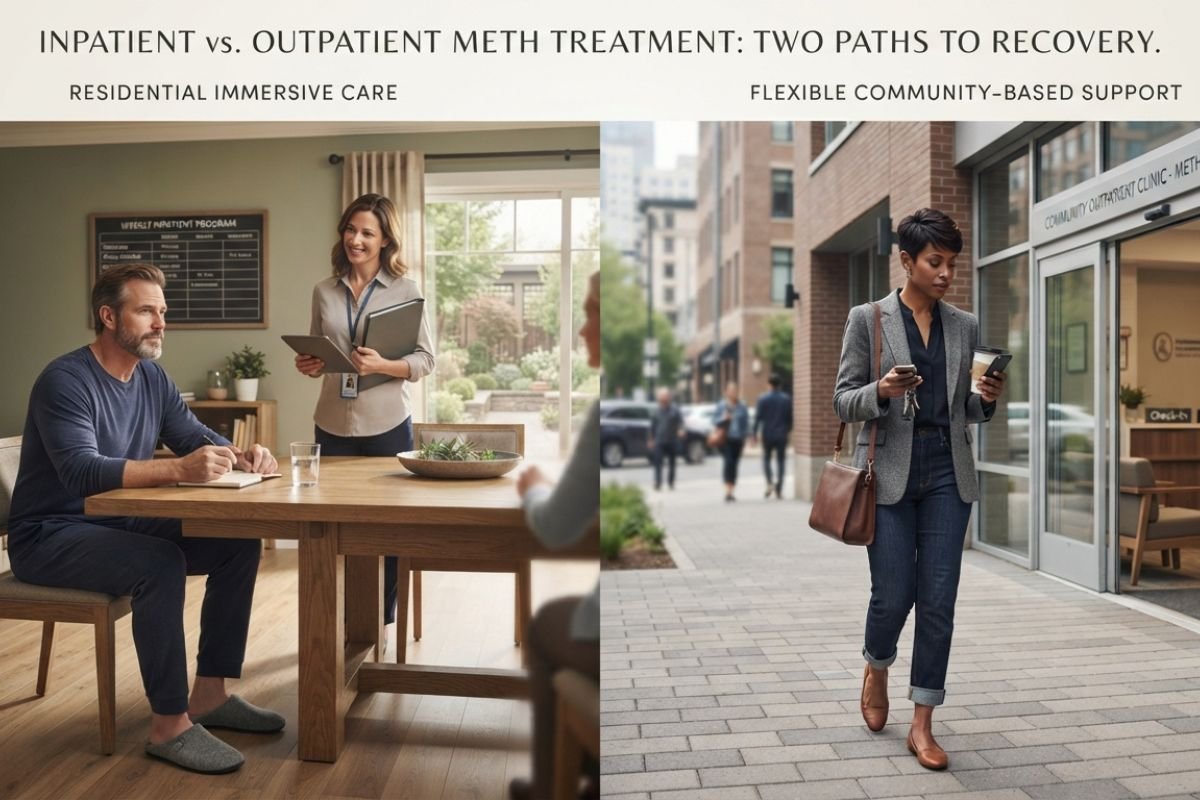
Meth addiction does not automatically require inpatient rehab.
Residential treatment may be appropriate when someone needs a structured environment, has significant psychiatric or medical symptoms, repeatedly struggles in less intensive treatment, uses multiple substances, or lacks a stable place to recover.
The site's inpatient drug rehab guide explains residential care in more detail.
Outpatient treatment allows the person to continue living outside the facility while attending scheduled treatment.
Depending on need, care may include standard outpatient therapy, intensive outpatient programming, PHP, contingency management, CBT, psychiatric services, or case management.
The outpatient drug rehab guide explains those treatment levels.
Methamphetamine use can occur alongside depression, anxiety, trauma-related conditions, and other mental-health disorders.
Meth intoxication or withdrawal can also contribute to paranoia, hallucinations, agitation, severe mood changes, or other psychiatric symptoms.
Treatment should therefore assess whether symptoms may be substance-related, part of another mental-health condition, or both.
Some symptoms improve after stimulant use stops, while others may require ongoing psychiatric treatment.
The site's dual diagnosis treatment guide provides a deeper explanation of coordinated addiction and mental-health care.
Severe psychosis, suicidal thoughts, violent behavior, extreme agitation, or inability to remain safe requires urgent professional evaluation.
Methamphetamine treatment today also needs to consider opioid exposure.
CDC and ASAM note that stimulant use can occur alongside opioids and that stimulant supplies may be contaminated with high-potency synthetic opioids such as fentanyl. CDC
Someone who intended to use only meth may therefore still face opioid-overdose risk.
Treatment assessment should ask about other substances, prior overdose, and possible fentanyl exposure.
For more information, readers can continue to the fentanyl addiction treatment guide.
Stimulant overdose may involve dangerously high body temperature, severe agitation, chest pain, irregular heartbeat, seizures, stroke-like symptoms, psychosis, or loss of consciousness.
CDC reported 28,722 overdose deaths involving the broader psychostimulant category in 2024. That rate fell significantly from 2023, but stimulant-related overdose remains a major health concern. CDC
Because fentanyl exposure may also occur, naloxone can be important whenever an opioid overdose is possible.
For severe chest pain, seizures, loss of consciousness, stroke-like symptoms, or another medical emergency, call 911.

A return to meth use should be taken seriously, but it does not automatically mean treatment has failed.
Treatment may need to be adjusted based on cravings, psychiatric symptoms, treatment intensity, living environment, other substance use, or barriers to attending care.
Keeping someone engaged in treatment can be important even when abstinence has not yet been sustained.
Treatment programs should focus on reassessment and safety rather than automatically treating renewed use as a reason to end care.
Look beyond whether a facility simply advertises “meth rehab.”
Ask which stimulant-specific behavioral treatments it actually provides.
Ask whether the program actually provides CM and how it is used.
Ask which stimulant-specific behavioral therapies are available.
Ask how severe depression, paranoia, psychosis, or other psychiatric symptoms are handled.
Ask how other substance use, prior overdose, and fentanyl exposure are assessed.
Ask what treatment remains available after the initial program.
The site's planned stimulant addiction treatment page can later serve as the broader parent resource for cocaine, methamphetamine, and other stimulant disorders.
Insurance may cover methamphetamine addiction treatment, but benefits vary by plan.
Residential care, outpatient therapy, PHP, IOP, psychiatric services, and other treatment services may have different network, authorization, deductible, copayment, and coinsurance requirements.
Readers can use the verify insurance for rehab resource to explore benefits or review how much rehab costs for broader cost information.
Yes. Methamphetamine use disorder can be treated with behavioral interventions, appropriate levels of addiction treatment, mental-health care, and continuing recovery support.
Contingency management has particularly strong evidence and is strongly recommended as a primary component of stimulant-use-disorder treatment. ASAM/AAAP
No. There is currently no FDA-approved medication specifically for methamphetamine use disorder. ASAM
Yes. CBT is one of the preferred behavioral approaches identified in current ASAM/AAAP stimulant-use-disorder guidance. ASAM/AAAP
The Matrix Model is a structured treatment approach developed for stimulant use disorders that combines behavioral therapy, education, relapse-prevention strategies, family involvement, and other recovery supports. SAMHSA
No. Some people can be treated successfully in outpatient programs. The appropriate level depends on medical, psychiatric, environmental, safety, and substance-use needs.
Yes. Depressed mood, fatigue, sleep changes, cravings, and difficulty experiencing pleasure can occur during meth withdrawal. Severe depression or suicidal thoughts require professional evaluation.
Methamphetamine use can be associated with paranoia, hallucinations, and other psychotic symptoms. Severe symptoms require prompt clinical evaluation.
The unregulated stimulant supply can be contaminated with fentanyl or other opioids, creating additional overdose risk. ASAM/AAAP
You do not have to decide by yourself whether residential rehab, outpatient treatment, contingency management, mental-health care, or another option is the right starting point.
Treatment can be explored based on meth use, withdrawal symptoms, psychiatric and physical health, other substance use, recovery environment, previous treatment, location, and insurance.
This page provides general educational information about methamphetamine use disorder, withdrawal, behavioral treatment, rehab, mental health, and overdose risk.
It is not medical advice, diagnosis, or an individualized treatment recommendation.
Severe paranoia, hallucinations, suicidal thoughts, chest pain, seizures, loss of consciousness, or other urgent symptoms require professional medical or psychiatric evaluation.
For a mental health, suicide, or substance-use crisis, call or text 988.