Home → Opioid Addiction Treatment
Opioid Use Disorder Treatment

Opioid Addiction Treatment: Medications, Rehab, and Recovery

Opioid addiction, clinically called opioid use disorder (OUD), is a treatable health condition involving a problematic pattern of opioid use that causes significant impairment or distress.

OUD can involve prescription opioids such as oxycodone or hydrocodone, heroin, fentanyl, or other opioids. Treatment is not limited to residential rehab or detox. Depending on the person's needs, evidence-based care can include medications for opioid use disorder, withdrawal management, outpatient or residential treatment, counseling, mental health care, overdose-prevention planning, and continuing recovery support.

Medication is especially important in opioid treatment. FDA-approved medications for OUD include buprenorphine, methadone, and naltrexone. Treatment with medications is associated with reduced opioid misuse, overdose risk, and death compared with receiving no treatment. U.S. Food and Drug Administration

Find Drug Rehab Options provides educational information and treatment-matching support. We are not a medical provider and do not provide medical advice, diagnosis, or treatment.
Adult discussing opioid addiction treatment with a behavioral health professional
Quick Answer

How Is Opioid Addiction Treated?

Opioid addiction is treated using an individualized plan that may combine medication, medical care, behavioral treatment, mental health services, and recovery support.

For many people with OUD, medication is a central part of care rather than an optional add-on. CDC recommends evidence-based medications for opioid use disorder and specifically warns that detoxification by itself, without ongoing MOUD, is not recommended because of increased risks of returning to opioid use, overdose, and overdose death. CDC

Treatment can happen in outpatient healthcare, opioid treatment programs, residential rehab, intensive outpatient programs, primary care, behavioral-health settings, or a combination of services over time.

Understanding OUD

What Is Opioid Use Disorder?

Opioid use disorder is the medical term commonly used for opioid addiction.

A person with OUD may have difficulty controlling opioid use even when it is causing problems with health, relationships, work, school, finances, safety, or other areas of life.

The condition is diagnosed based on a broader pattern of behavior and symptoms rather than simply whether someone has ever experienced withdrawal.

CDC notes that OUD can involve using more opioids than intended, unsuccessful efforts to reduce use, strong cravings, continued use despite harm, difficulty fulfilling responsibilities, hazardous use, and other signs. Tolerance and withdrawal may also be relevant, although those two criteria are handled differently when opioids are being taken solely under appropriate medical supervision. CDC

This distinction matters because physical dependence is not automatically the same as opioid addiction.

Opioid Types

Which Opioids Can Lead to Opioid Use Disorder?

OUD can develop in connection with several types of opioids.

Prescription

Prescription Opioids

Prescription opioids include medications such as oxycodone, hydrocodone, morphine, and others used in medical care.

Illicit Opioid

Heroin

Heroin is an illicit opioid.

Synthetic Opioids

Fentanyl

Fentanyl has legitimate medical uses but is also manufactured illegally. Illegally made fentanyl may be present in counterfeit pills or mixed with other drugs without a person's knowledge.

Read the fentanyl addiction treatment guide →
2024 U.S. Data

How Common Is Opioid Use Disorder?

4.8 million people aged 12 or older in the United States had opioid use disorder in the past year in 2024.
17.0% of people with past-year OUD — about 818,000 people — received medication for OUD during 2024.

That treatment gap is important because medication is one of the strongest evidence-based tools available for OUD. SAMHSA

The overdose burden also remains substantial. Final CDC data show that 54,045 U.S. overdose deaths in 2024 involved an opioid. Of those, 47,735 involved synthetic opioids other than methadone, a category that includes fentanyl but is not a fentanyl-only count. Opioid overdose mortality declined significantly from 2023 to 2024, but thousands of deaths still occurred. CDC

Assessment Signals

What Are Signs That Opioid Use May Need Professional Assessment?

Someone may benefit from professional assessment when opioid use becomes difficult to control or repeatedly interferes with everyday life.

A person may find that they use opioids longer or in larger amounts than intended, repeatedly try to cut down without success, experience strong cravings, or spend increasing amounts of time obtaining, using, or recovering from opioids.

Work, school, family responsibilities, relationships, health, or safety may also begin to suffer.

Continued opioid use despite recognizing serious physical, psychological, or social consequences can be another sign that professional evaluation is appropriate.

You do not need to diagnose yourself before asking about treatment.

Loss of Control
Cravings
Life Disruption
Continued Use Despite Harm
Starting Care

How Does Opioid Addiction Treatment Begin?

Treatment typically begins with an assessment.

A healthcare or addiction professional may review the opioids being used, recent fentanyl exposure, withdrawal symptoms, overdose history, other substance use, medications, physical health, mental health, previous treatment, living environment, support system, and treatment goals.

The goal is to determine what the person needs now rather than automatically placing everyone into the same program.

Someone may need withdrawal-management services first. Another person may be able to begin medication treatment in an outpatient setting. A person with significant medical, psychiatric, or environmental risks may need more structured care.

Learn how addiction treatment works →

Clinician and patient discussing an individualized opioid addiction treatment plan
1
Assessment
2
Stabilization
3
Treatment Plan
4
Progress Review
5
Continuing Care
Withdrawal Management

What Happens During Opioid Withdrawal?

When someone has developed physical dependence on opioids, reducing or stopping opioid use can cause withdrawal.

Symptoms can include restlessness, anxiety, sweating, muscle aches, trouble sleeping, stomach discomfort, nausea, vomiting, diarrhea, and strong cravings.

The experience can vary substantially depending on the opioid involved, pattern of use, other substances, medications, health conditions, and individual factors.

A rigid online “Day 1 through Day 7” detox timeline is therefore not appropriate for everyone.

When withdrawal-management services are needed, they may provide symptom monitoring, supportive care, medication, and stabilization.

However, withdrawal management is only one part of treatment.

Read the drug detox programs guide →

Withdrawal ≠ Complete OUD Treatment
Detox vs Ongoing Care

Is Detox Enough for Opioid Addiction?

No.

What Detox Can Do

Detox can help someone through immediate withdrawal and may provide monitoring, supportive care, medication, and stabilization.

What Ongoing OUD Treatment Does

After withdrawal, cravings, reduced tolerance, mental health symptoms, unstable living conditions, triggers, and other risks can remain. Continuing care addresses the full opioid use disorder rather than withdrawal alone.

CDC specifically advises against detoxification alone without medication treatment for OUD because it can increase the risk of returning to opioid use, overdose, and overdose death. CDC

This is especially important because opioid tolerance can fall after a period of reduced or no use. Returning to an amount previously tolerated may become much more dangerous.

Medication Treatment

What Medications Are Used to Treat Opioid Addiction?

FDA-approved medications for OUD include buprenorphine, methadone, and naltrexone. All three are evidence-based treatment options. U.S. Food and Drug Administration

Clinician discussing medication options for opioid use disorder treatment
Partial Opioid Agonist

Buprenorphine

Buprenorphine can reduce withdrawal symptoms and cravings.

It can be prescribed in office-based healthcare and other eligible settings. The former federal DATA or “X-waiver” is no longer required for qualified prescribers, although clinicians must still follow applicable federal and state requirements. FDA

Full Opioid Agonist

Methadone

Methadone is used to reduce withdrawal and cravings and help stabilize opioid use.

In the United States, methadone used specifically to treat OUD is generally dispensed through a SAMHSA-certified opioid treatment program. Federal OTP rules were substantially updated in 2024 to allow more individualized treatment. SAMHSA

Opioid Antagonist

Naltrexone

Naltrexone blocks opioid effects rather than activating opioid receptors. Extended-release injectable naltrexone is FDA-approved for OUD.

Because opioids need to be cleared appropriately before naltrexone is started, initiation should be managed by a qualified healthcare professional rather than through a self-directed schedule.

Evidence-Based Access Medication should not be withheld because counseling is unavailable.

Does Someone Have to Complete Counseling Before Receiving OUD Medication?

No.

Counseling and behavioral healthcare can be useful, but medication should not automatically be delayed because counseling is unavailable or because a patient declines a particular psychosocial service.

FDA guidance states that OUD medication should include an offer of counseling or other services when possible, but access to medication should not be made contingent on participation in those services. FDA

SAMHSA's updated OTP rules similarly state that medication access is no longer contingent on counseling participation. SAMHSA

The right treatment plan can still include individual counseling, group therapy, family support, peer services, psychiatric care, or other behavioral-health treatment when those services are helpful.

Behavioral Treatment

What Role Does Therapy Play in Opioid Treatment?

Medication can address important biological aspects of OUD, including withdrawal and cravings.

Therapy can address other areas of recovery.

Someone may work on triggers, stress, relationships, decision-making, trauma, mental health, motivation, daily routines, and strategies for difficult situations.

Treatment may involve individual counseling, group treatment, family services, cognitive and behavioral approaches, motivational strategies, or other services.

The best approach should be individualized rather than requiring every person with OUD to complete the same counseling program.

Understand Triggers
Build Skills
Strengthen Recovery Support
Level of Care

Inpatient vs. Outpatient Opioid Treatment

Higher Structure
More Community-Based Care

Residential / Inpatient Treatment

Opioid use disorder does not automatically require inpatient rehab.

Residential or inpatient treatment may be appropriate when someone needs a highly structured environment, has significant medical or psychiatric needs, lives in an unstable recovery environment, or has other risks that make community-based treatment difficult.

Read the inpatient drug rehab guide →

Outpatient Treatment

Outpatient treatment allows someone to live outside the facility while attending scheduled medical, counseling, or recovery services.

Outpatient OUD treatment may include buprenorphine or naltrexone, counseling, psychiatric services, telehealth, and other care depending on the provider.

Read the outpatient drug rehab guide →

Methadone treatment for OUD is generally provided through certified OTPs rather than ordinary outpatient prescribing.

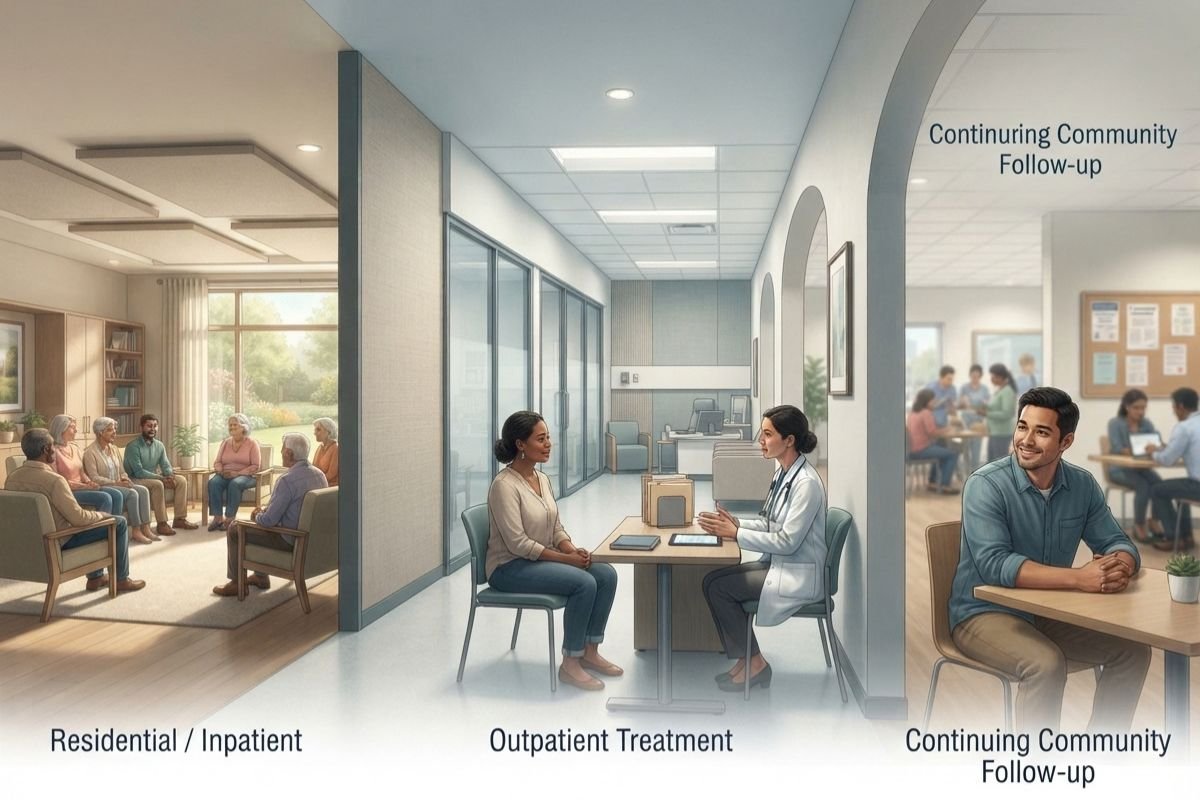
Comparison of inpatient and outpatient opioid addiction treatment settings
Co-Occurring Conditions

What If Mental Health Problems Are Also Present?

Depression, anxiety, PTSD, bipolar disorder, and other mental health conditions can occur alongside opioid use disorder.

When both are present, treatment may need to address both conditions together.

Mental health symptoms can affect substance use, sleep, safety, treatment participation, medication decisions, and recovery.

A coordinated approach can include addiction medication, psychotherapy, psychiatric care, case management, and other support.

Read the dual diagnosis treatment guide →

Opioid Use Disorder
Mental Health
Coordinated Care
Maternal Health

Opioid Addiction Treatment During Pregnancy

Pregnancy changes how opioid use disorder should be treated.

Current CDC guidance recommends methadone or buprenorphine for pregnant patients with OUD rather than rapidly stopping opioids or routinely using supervised withdrawal as the preferred approach. CDC

Prenatal and addiction-treatment clinicians should coordinate care.

Someone who is pregnant or may be pregnant should not stop OUD medication or attempt opioid withdrawal based solely on information from a website.

Overdose Safety

Overdose Prevention Should Be Part of Opioid Treatment

Opioid treatment should address overdose risk as well as longer-term recovery.

Naloxone can temporarily reverse an opioid overdose and should be available when opioid exposure is possible.

Even people receiving effective OUD treatment may still face overdose risk if they return to opioid use, use other substances, or experience changes in tolerance.

FDA encourages clinicians treating OUD to discuss naloxone, and treatment programs should include overdose education as part of safety planning. FDA

If someone may be experiencing an opioid overdose, give naloxone if available and call 911 immediately.

Naloxone is emergency overdose reversal; it does not replace ongoing OUD treatment.

Overdose prevention and naloxone education during opioid addiction treatment
Treatment Adjustment

What Happens If Someone Returns to Opioid Use?

A return to opioid use can be dangerous, but it does not automatically mean treatment should end.

It may indicate that medication, treatment intensity, mental health care, housing, recovery support, or another part of the treatment plan needs to be reassessed.

Stopping effective medication as punishment for continued or renewed substance use can create additional risk.

Treatment should focus on safety, updated clinical needs, and continued engagement in care.

Treatment
Return to Use
Reassessment
Adjusted Treatment Plan
Treatment Duration

How Long Does Opioid Addiction Treatment Last?

Treatment Duration = Needs + Response + Ongoing Reassessment

There is no universal treatment length.

Someone may spend a short period in residential care and then continue outpatient medication and counseling.

Another person may never need residential treatment at all.

Medication for OUD may continue for months, years, or longer when it remains beneficial.

Treatment should not be stopped simply because an arbitrary calendar date has been reached.

The appropriate duration depends on the person's response to treatment, safety, goals, medical needs, recovery environment, and preferences.

Program Verification

How Do You Choose an Opioid Addiction Treatment Program?

A treatment program should be able to explain how it assesses opioid use disorder and how it decides which level of care is appropriate.

For OUD, one of the most important questions is whether the program provides or coordinates evidence-based medication.

OUD Assessment

How does the program assess opioid use disorder and level of care?

Medication Access

Are buprenorphine, methadone, and naltrexone provided or coordinated when appropriate?

Withdrawal Support

How does the program handle withdrawal and stabilization needs?

Overdose Prevention

Does care include naloxone education and overdose-risk planning?

Mental Health

Can the program address or coordinate co-occurring psychiatric needs?

Continuing Care

How are medications, recovery services, and follow-up coordinated after discharge?

“If I have opioid use disorder, how will your program provide or coordinate medication treatment?”

That answer can reveal more about the program's clinical model than simply asking whether it offers “opioid rehab.”

Coverage

Does Insurance Cover Opioid Addiction Treatment?

Insurance may cover opioid use disorder treatment, but the details depend on the specific plan.

Treatment Coverage

Residential care, outpatient treatment, physician services, OTP services, and psychiatric care may be processed differently under an insurance plan.

Medication Coverage

Prescription medication benefits, prior authorization, networks, deductibles, copayments, and coinsurance may affect what a person pays.

Marketplace health plans cover mental health and substance use disorder services as essential health benefits, although deductibles, copayments, coinsurance, provider networks, authorization rules, and specific medication benefits can still affect what a person pays. HealthCare.gov

Insurance verification does not guarantee authorization, payment, admission, or final patient responsibility.
FAQ

Frequently Asked Questions About Opioid Addiction Treatment

Is opioid addiction treatable?

Yes. Opioid use disorder is treatable. Treatment can include medication, behavioral healthcare, medical services, mental health treatment, overdose prevention, and ongoing recovery support.

What medications are used to treat opioid addiction?

FDA-approved medications for OUD are buprenorphine, methadone, and naltrexone. FDA

Is opioid detox enough?

No. Withdrawal management can address immediate withdrawal, but CDC advises against detoxification alone without continuing OUD treatment because of increased return-to-use and overdose risks. CDC

Does everyone with opioid addiction need inpatient rehab?

No. OUD can be treated in several settings. The appropriate level of care depends on medical needs, withdrawal, mental health, overdose risk, living environment, and other individual factors.

Can opioid addiction be treated with Suboxone?

Buprenorphine-containing medications, including buprenorphine/naloxone products, are FDA-approved treatment options for OUD.

Is methadone replacing one opioid with another?

Methadone is an FDA-approved medication for opioid use disorder. When provided through treatment, it is used to reduce withdrawal and cravings and support stabilization.

Can fentanyl addiction be treated with OUD medications?

Yes. Fentanyl-related opioid use disorder can be treated using evidence-based OUD medications. The medication and initiation approach should be selected with a qualified clinician.

Does counseling have to happen before medication?

No. Counseling can be useful, but medication access should not be denied or delayed solely because counseling is unavailable or declined. FDA

How long does opioid addiction treatment last?

There is no universal duration. Treatment and medication may continue as long as they remain clinically appropriate and beneficial.

What should I do if someone overdoses?

Give naloxone if available and call 911 immediately.

Explore Care

Explore Opioid Addiction Treatment Options

You do not need to know whether medication, detox, inpatient rehab, or outpatient treatment is the right starting point before asking about available options.

Treatment can be explored based on opioid use, withdrawal risk, overdose history, physical and mental health, living environment, location, insurance, and other individual circumstances.

Find Drug Rehab Options provides educational information and treatment-matching support. We are not a medical provider and do not diagnose opioid use disorder, prescribe medication, or provide treatment. Exploring treatment options does not guarantee admission or insurance coverage.
Written By: Find Drug Rehab Options Editorial Team
Last Updated: September 2026
Important Information

Medical and Emergency Disclaimer

This page provides general educational information about opioid use disorder, withdrawal, medications, rehab, and overdose prevention. It is not medical advice, diagnosis, medication guidance, or an individualized treatment recommendation.

Do not start, stop, change, or taper medication based solely on information from this page.

Questions about withdrawal, pregnancy, medications, mental health symptoms, or treatment decisions should be discussed with appropriately qualified healthcare professionals.

If someone may be experiencing an opioid overdose or another medical emergency in the United States, give naloxone if available and call 911 immediately.

If someone is experiencing a mental health, suicide, or substance use crisis, call or text 988.