

Drug rehab, short for drug rehabilitation, is structured treatment designed to help people address harmful drug use or a substance use disorder and improve their health, daily functioning, and long-term recovery stability.
Rehab is not one specific building, therapy, or fixed-length program. Depending on a person’s needs, addiction treatment may include assessment, withdrawal management, counseling, behavioral therapy, medications, residential care, outpatient treatment, mental health services, case management, peer support, and continuing care.
The right treatment plan should be based on the person’s actual needs rather than assuming everyone should complete the same type of program. Someone may need residential care, while another person may be better suited to outpatient treatment. Some people need withdrawal management before treatment begins, while others can start directly with counseling, medication, or another form of care.
If you are researching treatment for yourself or someone you care about, understanding what drug rehab actually involves can make it much easier to compare programs and ask better questions.
What Is Drug Rehab?
Drug rehab is a broad term for structured treatment that helps people address problems related to alcohol or drug use.
Treatment may focus on substance use patterns, withdrawal, cravings, physical health, mental health, relationships, work, family responsibilities, and other areas of life that may have been affected.
Rehab can take place in many settings. Some people receive care in residential treatment centers, while others attend outpatient clinics and continue living at home. Treatment can also involve hospitals, behavioral health programs, primary care providers, medication clinics, or several different services working together.
A useful way to think about rehab is as a treatment process rather than simply a place.
Drug Rehab Is More Than a Residential Facility
Many people hear the word “rehab” and immediately imagine someone staying in a treatment center for 30 days. Residential treatment is one form of rehab, but it is only one part of the addiction-treatment system.
For one person, treatment may involve living at a residential facility and participating in therapy and other structured services throughout the day. Another person may receive appropriate treatment through outpatient counseling while continuing to work and live at home. Someone with opioid use disorder may receive medication alongside counseling or other healthcare services. A person with both substance use and mental health conditions may need treatment that addresses both problems together.
This is why a better question is not simply, “Which rehab facility should I choose?” A more useful question is, “What services and level of care does this person actually need?”
That distinction becomes especially important when comparing treatment programs.
What Does Drug Rehab Help Address?
Substance use can affect much more than the substance itself. It may affect physical health, emotional wellbeing, relationships, employment, education, housing, finances, safety, and everyday responsibilities.
Because of this, effective addiction treatment often takes a broader approach. A person may need help stabilizing their health, managing cravings, understanding triggers, developing coping skills, treating depression or anxiety, rebuilding relationships, addressing housing or transportation problems, and preparing for continued treatment after the initial program ends.
Good treatment should therefore focus on the whole person rather than only asking whether the person is currently using drugs.
Is Rehab Always a 30-Day Program?
No. There is no single rehab length that is appropriate for everyone.
You may see programs advertised as 30-day, 60-day, or 90-day treatment, but the calendar alone should not determine how much treatment someone needs. A person may need only a short period of medically supported withdrawal management before moving into another program, while someone else may need several months of treatment across multiple levels of care.
Treatment is better understood as a process of assessment, treatment, reassessment, and transition. As a person’s needs change, the level or type of care may also change.
For example, someone might begin in residential treatment, then move into an intensive outpatient program, later continue with standard outpatient counseling, and eventually rely mainly on medication management and community recovery support.

How Does Drug Rehab Work?
Drug rehab usually begins with an assessment. A treatment professional may ask about the person’s substance use, withdrawal risk, medical history, mental health, medications, previous treatment, living situation, support system, and treatment goals.
That assessment helps determine what type of care may be appropriate.
Some people need withdrawal management before other treatment can begin. This is commonly called detox. Not everyone needs a separate detox program, and the need depends on the substance involved, physical dependence, withdrawal risk, health conditions, and other factors. Our guide to Drug Detox Programs explains this stage in much more detail.
After the initial assessment, treatment may take place in residential care, partial hospitalization, intensive outpatient treatment, standard outpatient care, or another setting.
The treatment itself may involve counseling, group therapy, behavioral treatment, mental health care, medication, recovery education, family services, and case management.
Treatment should also include regular progress reviews. If a person’s needs change, the treatment plan may need to change as well. For a full step-by-step explanation of the treatment journey, our [How Does Rehab Work?](/how-does-rehab-work/) guide goes deeper into assessment, treatment, discharge planning, and continuing care.
Is Detox the Same as Drug Rehab?
No. Detox and rehab are connected, but they serve different purposes.
Detox, or withdrawal management, focuses mainly on helping a person safely manage the physical and psychological effects that can occur when a substance is stopped or reduced. Depending on the substance and the person’s health, this may involve medical monitoring, medications, symptom management, and stabilization.
Drug rehab addresses the broader substance use disorder. It may involve behavioral therapy, counseling, medications, mental health treatment, recovery planning, case management, and long-term support.
Detox can therefore be one part of addiction treatment, but completing detox does not necessarily mean treatment is finished.
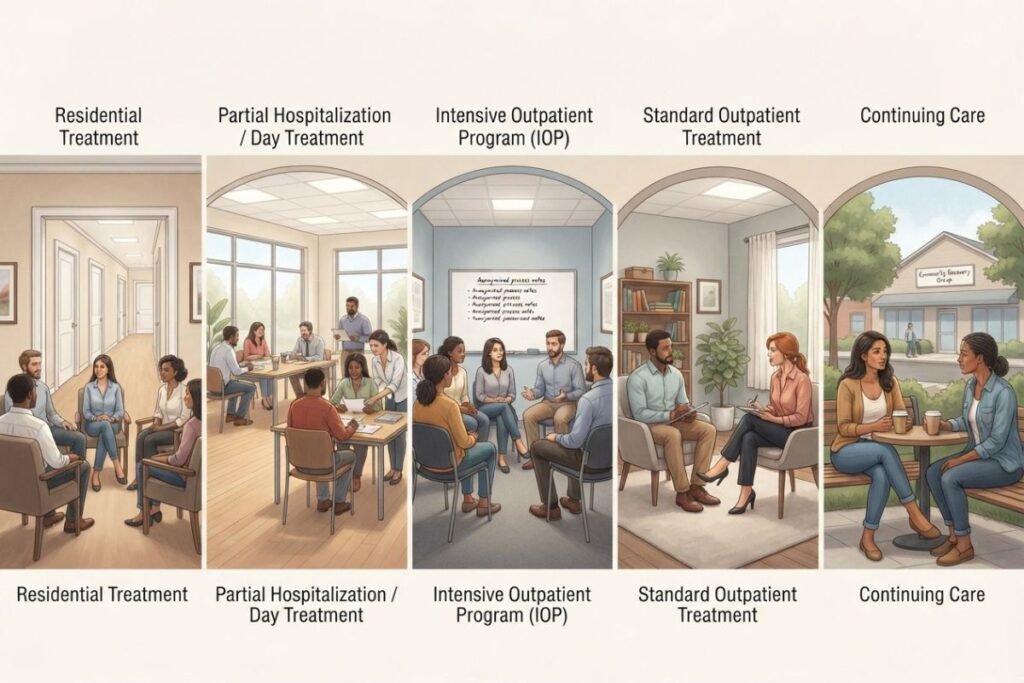
What Are the Different Types of Drug Rehab?
Drug rehab can take place at different levels of intensity. The most appropriate setting depends on clinical needs, safety, health, recovery environment, and the amount of structure required.
Inpatient and Residential Rehab
Residential treatment means the person lives in the treatment environment rather than returning home after scheduled treatment sessions.
This type of care can provide a more structured daily routine, separation from some outside triggers, regular access to staff, therapeutic services, and a controlled living environment.
People who want to understand how residential treatment works can read our Inpatient Drug Rehab guide.
Partial Hospitalization Programs
A partial hospitalization program, often called PHP, provides highly structured treatment during the day while the person usually lives elsewhere.
PHP can provide many hours of treatment each week without requiring full residential living.
Intensive Outpatient Programs
An intensive outpatient program, or IOP, provides more treatment hours than standard outpatient care while allowing someone to continue living in the community.
An IOP may include multiple therapy sessions, individual counseling, medication appointments, mental health treatment, and recovery planning throughout the week.
Standard Outpatient Treatment
Standard outpatient treatment usually involves scheduled treatment while the person continues living at home and managing normal daily responsibilities.
Treatment may include individual counseling, group therapy, psychiatric care, medication management, and other services based on the person’s needs.
Our Outpatient Drug Rehab guide explains standard outpatient care, IOP, PHP, telehealth, and how outpatient treatment fits into the broader continuum of care.
Dual Diagnosis Treatment
Some people experience both a substance use disorder and a mental health condition such as depression, anxiety, PTSD, bipolar disorder, or another psychiatric condition.
When this happens, coordinated treatment can address both problems rather than treating one and ignoring the other. You can read more about this approach in our Dual Diagnosis Treatment guide.
Medication-Based Addiction Treatment
Medication can also be a major part of treatment for certain substance use disorders.
For opioid use disorder, medications such as buprenorphine, methadone, and naltrexone may be used as part of evidence-based treatment. Our Medication-Assisted Treatment guide explains how medication can fit into addiction care.
Inpatient vs. Outpatient Rehab
Inpatient and outpatient treatment are different mainly in where the person lives and how much structure the program provides. In residential treatment, the person stays within the treatment environment. Meals, therapy, structured activities, and other parts of the day happen inside the program.
Outpatient treatment allows the person to live outside the program and attend treatment during scheduled hours. This may make it easier to continue some work, education, parenting, or other responsibilities.
Neither option is automatically better.
A person may need more structure because of withdrawal risk, mental health concerns, an unsafe living situation, repeated difficulty remaining stable outside treatment, or other clinical needs. Another person may be able to safely participate in treatment while continuing to live in the community.
The decision should depend on the individual’s needs rather than assuming that residential treatment is always stronger or outpatient treatment is always easier.

What Happens in Drug Rehab Every Day?
There is no universal rehab schedule.
What someone does each day depends on the level of care, the treatment program, clinical needs, medications, mental health, and the person’s individual treatment plan.
A typical residential program may include individual counseling, group sessions, recovery education, medication appointments, meals, case management, wellness activities, and time for personal reflection or recovery planning.
Outpatient treatment works differently because treatment is scheduled around the person’s life outside the program. The quality of treatment matters more than simply how many activities appear on the daily schedule.
What Types of Therapy Are Used in Drug Rehab?
Individual counseling is common in addiction treatment. These sessions may focus on substance-use patterns, triggers, emotions, relationships, stress, coping strategies, and recovery goals.Group therapy can provide a structured environment where people work on recovery-related topics with treatment professionals and other participants.
Behavioral treatment may help people identify connections between thoughts, feelings, triggers, and substance use, and then practice different responses.Some programs also offer family therapy or education when family involvement is appropriate.The exact therapies should depend on the person’s needs rather than every patient receiving exactly the same treatment plan.

Can Medication Be Used During Rehab?
Yes.
Medication can be an important part of addiction treatment when clinically appropriate.
For opioid use disorder, evidence-based medication options include buprenorphine, methadone, and naltrexone. Medication can help with withdrawal, cravings, stabilization, or treatment of the substance use disorder itself.
Medication may also be used for alcohol use disorder or for co-occurring mental health conditions. Medication should not be viewed as separate from “real recovery.” In many cases, it is part of evidence-based addiction treatment.
What If Mental Health Problems Are Also Present?
Substance use and mental health problems frequently occur together. Someone entering treatment may also be dealing with depression, anxiety, trauma-related symptoms, bipolar disorder, ADHD, or another mental health condition.
If addiction treatment focuses only on substance use while leaving important psychiatric needs untreated, the person may continue struggling even after drug use is reduced.
Integrated treatment attempts to address both substance use and mental health needs together. Our Dual Diagnosis Treatment guide explains how this coordinated approach works.
How Do You Know When Rehab May Be Needed?
There is no single amount of drug use that automatically determines whether someone needs rehab.
Treatment may be worth discussing when substance use has become difficult to control or is repeatedly affecting health, relationships, work, school, finances, safety, or daily responsibilities.
Other warning signs can include strong cravings, withdrawal, increasing tolerance, repeated unsuccessful attempts to stop, continued use despite serious consequences, or repeatedly returning to substance use after trying to quit.
A website cannot diagnose a substance use disorder or determine the correct level of care. You also do not need to diagnose yourself before asking about treatment. A qualified healthcare or addiction professional can assess the situation and help determine which options may be appropriate.
How Long Does Drug Rehab Last?
There is no single correct length of treatment.
Treatment duration may depend on the substance involved, withdrawal risk, physical health, mental health, medications, recovery environment, treatment response, and the person’s progress.
Someone may begin with intensive treatment and later move into less intensive care while still remaining engaged in recovery services. Instead of focusing only on whether a program lasts 30, 60, or 90 days, it is often more useful to ask:
What treatment does this person need now, and what should happen after this level of care ends?
Does Drug Rehab Work?
Appropriate addiction treatment can help people reduce harmful substance use, improve physical and mental health, strengthen functioning, and develop greater recovery stability. However, no responsible treatment program can guarantee permanent recovery after one treatment episode.
Substance use disorders can require ongoing care. Someone may need medication, outpatient treatment, mental health services, additional treatment episodes, or other recovery support after the first program ends.
This is why the goal should not simply be to “finish rehab.” The larger goal is to build a treatment and recovery plan that can continue helping the person over time.

What Happens After Rehab?
Leaving residential or intensive treatment is often the beginning of another stage of recovery rather than the end of care.
Continuing treatment may include outpatient counseling, medication management, mental health services, primary care, peer support, recovery housing, family services, case management, and community recovery programs.
For example, someone leaving residential treatment may move into an intensive outpatient program and later continue with standard outpatient counseling.
A person taking medication for opioid use disorder may continue medication long after residential treatment ends. The right continuing-care plan depends on the person’s health, risks, living environment, support system, and recovery goals.
How to Choose a Drug Rehab Program
Choosing a treatment program should involve more than comparing websites, amenities, or advertising claims.
A treatment center should be able to explain what level of care it provides, why that level may be appropriate, who provides medical and psychiatric services, what types of therapy are offered, whether medications are available, and how mental health conditions are treated.
You should also ask how often treatment plans are reviewed and what happens when the current program ends. Terms such as “luxury,” “exclusive,” “holistic,” or “transformational” may describe how a program markets itself, but they do not by themselves tell you whether the clinical care is appropriate.
Before choosing a program, ask how the level of care is determined, what happens during assessment, whether withdrawal management is available, what therapies are used, whether medications are offered, how mental health problems are handled, how discharge is planned, whether the program is in-network with your insurance, and what costs you may personally be responsible for.
A treatment program should be able to clearly explain what it actually does.
How Much Does Drug Rehab Cost?
There is no single nationwide price for addiction treatment.
Cost varies according to the treatment setting, clinical services, staffing, length of treatment, medications, location, housing, meals, and insurance arrangements.
Residential treatment generally has a different cost structure from outpatient care because housing and around-the-clock program support may be included.
If cost is one of your main concerns, our How Much Does Rehab Cost? guide explains treatment pricing, insurance, and potential patient responsibility in more detail.
Does Insurance Cover Drug Rehab?
Health insurance may cover substance use disorder treatment, but the amount covered depends on the specific plan and treatment being requested.
Coverage may be affected by provider network status, prior authorization, medical-necessity requirements, deductibles, copayments, coinsurance, and the level of care.
Because benefits vary significantly, insurance should be verified whenever possible before admission.
You can use our insurance verification resource to explore what your plan may cover, although verification does not guarantee authorization, admission, payment, or a particular out-of-pocket cost.
Is drug rehab only inpatient treatment?
No. Drug rehab can include residential treatment, partial hospitalization, intensive outpatient care, standard outpatient treatment, medication-based care, and continuing recovery services.
Does everyone need detox before rehab?
No. Some people require withdrawal management, while others can begin treatment without a separate detox program. The need depends on the substance, physical dependence, withdrawal risk, health, and other factors.
Is detox the same as rehab?
No. Detox primarily focuses on withdrawal and stabilization. Rehab addresses broader addiction-treatment needs such as therapy, medications, mental health care, recovery planning, and continuing support.
Can rehab treat mental health conditions?
Yes, some treatment programs provide integrated care for both substance use disorders and mental health conditions.
What happens after rehab?
Many people continue with outpatient treatment, medications, mental health care, peer support, healthcare follow-up, recovery housing, or other recovery services.
How do I choose the right rehab?
Look beyond advertising and compare clinical services, staff qualifications, treatment methods, medication access, mental health services, insurance participation, costs, and continuing-care planning.